
The Everything Machine: Alphabet’s AI Flywheel
March 25, 2026
The SpaceX Rocket
June 18, 2026NVIDIA Corporation: A Fenestra Favourite
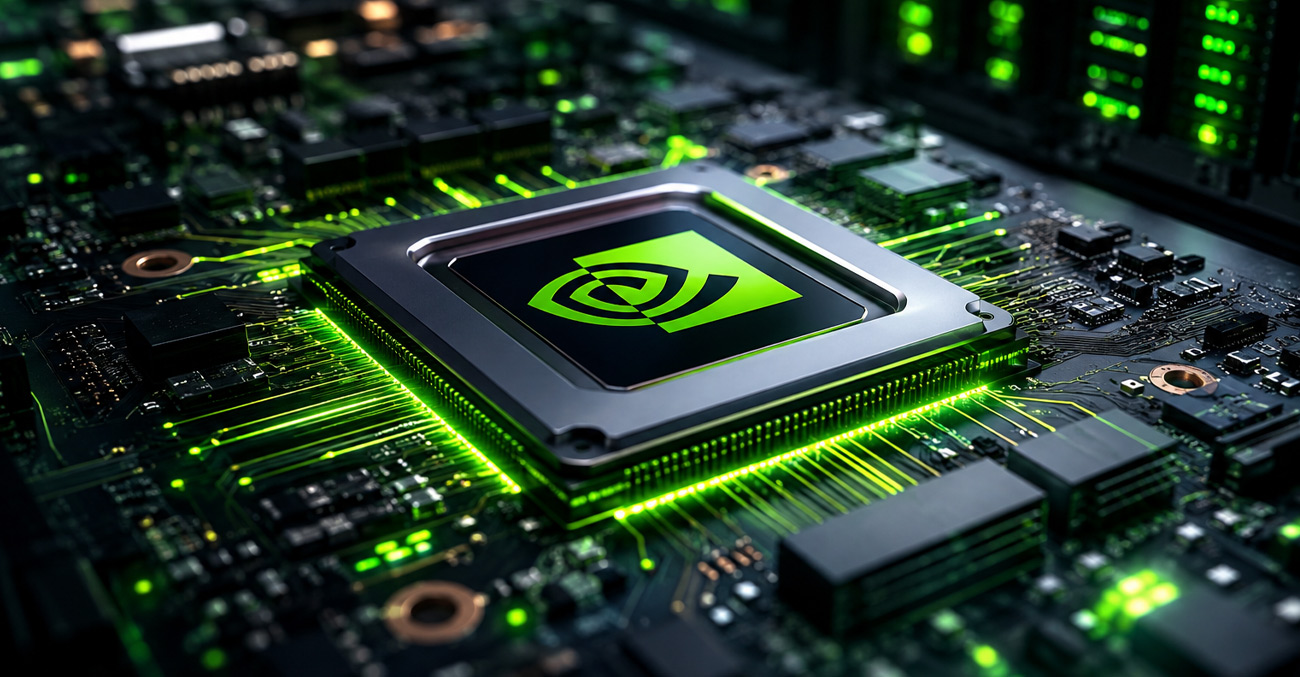
NVIDIA Corporation remains a long-time Fenestra favourite, supported by its leadership in AI infrastructure, GPUs and data centre technology.
NVIDIA Corporation: A Fenestra Favourite in the AI Investment Era
Readers will know that NVIDIA has long been a Fenestra favourite and has remained a top holding in client portfolios for many years. NVIDIA is scheduled to report its fiscal Q1 2027 results on 20 May 2026, and investor attention will once again be focused on one of the world’s most valuable companies. While short-term share-price reactions can never be guaranteed, Fenestra believes that NVIDIA remains exceptionally well positioned if earnings continue to exceed market expectations.
Why NVIDIA Remains our Favourite
The Fenestra investing style follows a GARP strategy: growth at a reasonable price. It is unusual to find a company of NVIDIA’s scale that still appears attractively valued when measured against its historical and prospective growth.
The combination of rapid earnings growth, a compelling growth-adjusted valuation, and a powerful competitive moat in AI infrastructure hardware and software places NVIDIA at the apex of Fenestra’s concentrated GARP ranking framework.
NVIDIA’s Position at the Centre of the AI Boom
NVIDIA Corporation designs and supplies graphics processing units, system-on-chip units, accelerated computing systems, networking solutions, and related software platforms. Originally best known for gaming graphics, NVIDIA has executed one of the most remarkable pivots in technology history, transforming itself into the dominant hardware and software platform for artificial intelligence. Its core growth engine is now the Data Centre segment, supported by Gaming, Automotive, OEM, and Professional Visualisation.
Why NVIDIA Leads the AI Infrastructure Stack
NVIDIA’s leadership is built on several reinforcing advantages, including GPU dominance, software lock-in through CUDA, vertical integration, and a next-generation product roadmap focused on the continued expansion of AI workloads.
GPU Dominance
NVIDIA’s H100, H200, Blackwell B200 and GB200 systems remain among the industry-standard accelerators for training and inference workloads.
Industry estimates continue to place NVIDIA as the clear leader in AI accelerators, with market share often estimated around 80% or higher.
CUDA Ecosystem Lock-In
CUDA was introduced by NVIDIA in 2006 and allows developers to use GPUs for general-purpose computing beyond graphics workloads.
This software ecosystem is a major competitive advantage. Years of developer adoption, libraries, frameworks, and codebases have created a powerful moat that is difficult for competitors to replicate quickly.
Vertical Integration
NVIDIA’s competitive strength is not limited to GPUs. The company combines GPUs, CPUs, high-speed NVLink interconnects, InfiniBand networking, rack-scale systems, and software into an integrated AI computing platform. NVIDIA describes the GB200 NVL72 as an exascale computer in a single rack, using 72 Blackwell GPUs connected through its NVLink system.
Next-Generation Roadmap
NVIDIA’s Vera Rubin platform is expected to extend the company’s AI infrastructure roadmap into the next phase of agentic AI and large-context inference. NVIDIA positions Vera Rubin NVL72 for the low-latency and large-context demands of agentic systems.
Agentic AI and Future Compute Demand
NVIDIA CEO Jensen Huang has highlighted the shift toward agentic AI systems, where autonomous agents operate continuously and generate sustained inference demand. This supports the view that future AI workloads may extend well beyond model training and into ongoing reasoning, inference, and token generation.
Hyperscaler Spending and NVIDIA’s Order Book
The hyperscaler capital expenditure cycle remains a critical driver of NVIDIA’s growth. Alphabet, Amazon, Meta, Microsoft and Oracle have been rapidly increasing infrastructure investment, with
Epoch AI estimating that combined hyperscaler capex could reach approximately $770 billion in 2026 if recent growth trends continue.
This spending is directly relevant to NVIDIA because AI data centres require massive investment in accelerated computing, networking, memory, power, and cooling infrastructure.
Conclusion: NVIDIA and the Future of AI Investing
NVIDIA remains one of the defining investments of the AI era. It is not merely a chip company; it is a core infrastructure provider for the global AI economy.
Its CUDA ecosystem moat is deep, its hardware roadmap continues to advance, and its exposure to hyperscaler AI spending remains substantial. From a GARP perspective, Fenestra believes NVIDIA offers a rare combination of scale, growth, profitability, and long-term strategic relevance.
If you are not happy with your portfolio performance, or would like a second opinion, please contact Fenestra for a free review of your portfolio.
William Meyer
079 624 4031
Extraordinary Profits from Ordinary Shares
FAQs
1. Why is NVIDIA important to the AI industry?
NVIDIA provides many of the GPUs, networking systems, software tools, and rack-scale platforms used to train and run advanced AI models.
2. What is CUDA and why does it matter?
CUDA is NVIDIA’s parallel computing platform. It allows developers to use GPUs for accelerated computing, and its wide adoption has created a powerful software moat for NVIDIA.
3. What is the GARP investment strategy?
GARP stands for growth at a reasonable price. It focuses on companies that offer strong growth potential while still trading at valuations that appear reasonable relative to their earnings prospects.
4. Why is hyperscaler spending important for NVIDIA?
Large cloud and technology companies are spending heavily on AI data centres. This infrastructure investment supports demand for NVIDIA’s GPUs, networking, and accelerated computing systems.
5. Is NVIDIA only a gaming company?
No. Although NVIDIA was historically known for gaming graphics, its largest growth driver is now AI data centre infrastructure, supported by software, networking, automotive, visualisation, and gaming businesses.